

2025 Budget: Higher Taxes, More Debt – But Still No Real Reform
Written by: CIBA – Posted on: 12/03/2025 – find original post here
The 2025 Budget Speech was meant to chart a way forward for South Africa’s struggling economy, but instead, it reinforces the same cycle of tax increases, growing debt, and inefficient spending. Finance Minister Enoch Godongwana announced a staggered VAT increase and no adjustments to personal income tax brackets, effectively forcing taxpayers to pay more without addressing the deeper fiscal crisis.
But will this fix South Africa’s financial challenges? No. Raising taxes while failing to address mismanagement, inefficiencies, and economic stagnation will only drive businesses away, increase unemployment, and put more pressure on households already struggling with the high cost of living.
Instead of asking South Africans to pay more for less, the government should fix what’s broken—recovering stolen funds, improving tax collection, and creating a business-friendly environment for growth.
What the 2025 Budget Proposes
The government has taken a two-pronged approach to raising revenue:
1. VAT increases — VAT will increase by 0.5% from May 2025, followed by another 0.5% increase in April 2026, pushing it up to 16%. While this is lower than the February proposal, it still affects every South African by making essentials more expensive. The expected revenue from this is R28 billion over two years. VAT zero-rated food items will expand to include offal meats, dairy liquid blends, and tinned vegetables to soften the impact.
2. Income Tax (IT):
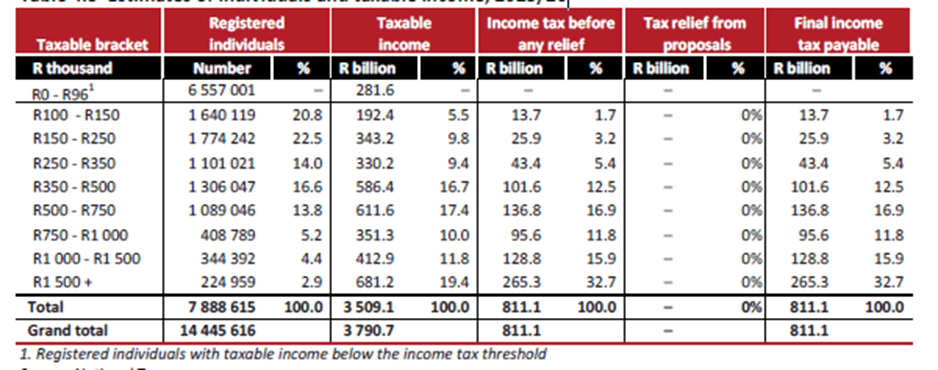
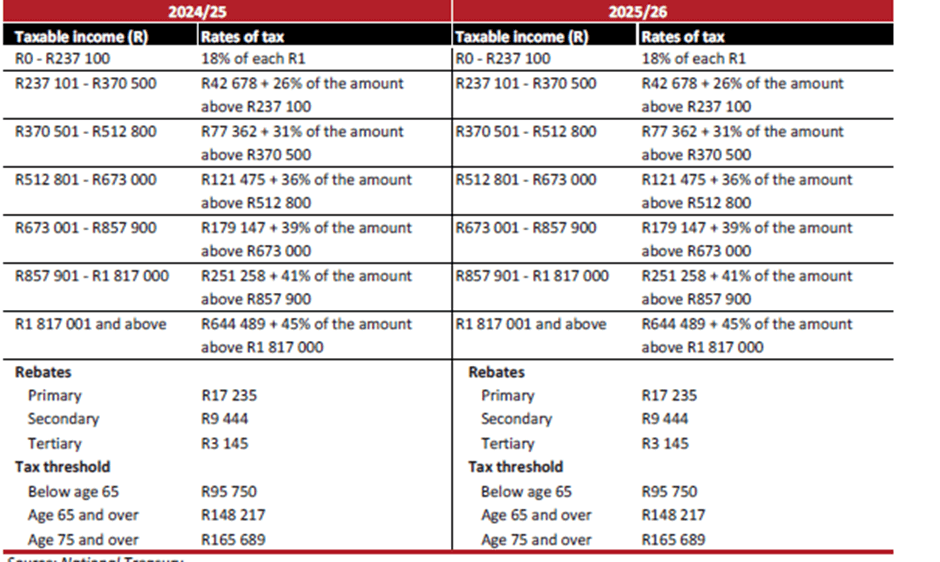
- Individuals — For the second year, the government has not adjusted personal tax brackets or rebates for inflation. This means anyone getting a salary increase just to keep up with inflation will be pushed into a higher tax bracket—a silent tax hike known as fiscal drag. Medical tax credits also remain unchanged.
- Companies — The rate of corporate income tax remains at 27%. The Global Minimum Tax Act charges a flat rate of 15% on multinationals irrespective of where they operate from, as of 1 January 2024.
- Trusts — No changes announced for trusts.
3. Capital Gains Tax — The inclusion rate for capital gains remains unchanged at 40% for natural persons and 80% for companies and trusts. This means the maximum CGT rates remain at:
- Individuals and special trusts – 18%
- Other trusts – 36%
- Companies – 21.6%
- Individual policyholder funds – 12%
4. Transfer Duty — Property buyers will benefit from an upward adjustment of 10% in transfer duty brackets from 1 April. The lowest bracket i.e. properties below R1.21m will incur no transfer duty.
5. Dividends Tax and Interest Exemptions — Dividends tax remains at 20% and no changes were made to the interest exemptions.
6. Estate Duty and Donations Tax — No changes announced.
7. No increase in fuel levies — Fuel levies remain unchanged, which is a small relief and will save consumers around R4 billion.
8. More funding for SARS — To improve tax collection and enforcement, the South African Revenue Service (SARS) will receive R3.5 billion this year and R4 billion over the medium term.
9. Public sector wage increases — A 5.5% salary increase for government employees, adding R7.3 billion in spending—despite the already unsustainable public wage bill.
10. More borrowing — South Africa’s national debt has grown from R2 trillion to R6 trillion in just a decade. 22nf every tax rand now goes toward debt repayments—more than what is spent on basic education, health, or policing.
Spending Measures (Where the Money is Going)
1. Debt Servicing Costs
R389.6 billion allocated to servicing debt, meaning 22 cents of every tax rand goes to debt repayment—more than what is spent on healthcare, policing, or education.
2. Public Sector Wage Bill Increases
Despite the already unsustainable wage bill, the government will spend R7.3 billion to fund a 5.5% wage increase for public sector workers.
3. Early Retirement Program for Public Servants
R11 billion allocated to incentivise 30,000 state employees to retire early, aiming to reduce long-term wage costs.
4. Social Grants Expansion
R284.7 billion allocated to social grants, with above-inflation increases:
- Old Age & Disability Grants: +R130 to R2,315 per month.
- Child Support Grant: +R30 to R560 per month.
- Foster Care Grant: +R70.
The COVID-19 Social Relief of Distress Grant (R350 per month) extended until March 2026.
5. Infrastructure Spending (R1 Trillion Over Three Years)
- R402 billion for transport and logistics (e.g., PRASA rail upgrades, road network improvements).
- R219 billion for energy infrastructure (Eskom stabilisation and renewable projects).
- R156 billion for water and sanitation.
Why This Is the Wrong Solution
While the government’s plan aims to close the fiscal gap, higher taxes and more debt will not fix South Africa’s economic problems. Here’s why:
1. South Africans already pay more, but get less
Tax revenue per person has increased nearly tenfold since 1994 – from R2,816 per person to R29,752 in 2024. Yet government service delivery has deteriorated. Despite paying more, South Africans face:
- Failing SOEs like Eskom and Transnet that cost the economy billions
- Poor healthcare and education services despite rising budgets
- Worsening crime and corruption, which deter investment and growth
2. Fiscal drag is a hidden tax increase
Because income tax brackets aren’t adjusted for inflation, taxpayers who receive a cost-of-living salary increase will automatically pay more taxes.
Estimated additional tax collected from fiscal drag is:
- 2025/26: R18 billion
- 2026/27: R19 billion
This is more than the VAT increase will raise!
3. South Africa’s growth is too weak to sustain more taxes
The budget assumes that raising VAT and PIT will generate more revenue, but economic growth has been too weak to support these assumptions.
The fiscal multiplier has collapsed, meaning government spending is shrinking the economy rather than stimulating it.
- 2009: Every R1 of spending created R1.40 in economic growth
- 2019: Every R1 of spending shrank the economy
With low growth, high unemployment, and poor investor confidence, increasing taxes will only make things worse.
Conclusion: Less Taxation, More Growth
The revised budget is not a solution—it’s a stopgap. South Africa will continue its low-growth, high-debt trajectory without real structural reforms. The government must boldly decide to reform itself before further burdening taxpayers.
At CIBA, we believe in a South Africa First approach:
- No more tax increases.
- No more bloated government.
- No more bailouts for failing SOEs.
Instead, South Africa needs:
✔️ An efficient, skilled public sector that delivers value.
✔️ Pro-business policies that foster economic growth.
✔️ A streamlined regulatory environment that attracts investment.
If government is serious about fixing the economy, it must start by fixing itself.
Read the Budget Highlights and the Budget 2025 Presentation – Investing for Faster Growth for more information.
Documents to Save
Click here to download the Speech Summary
Click here to download the Info Graphic
Click here to download the Economic Impact
Click here to download the SARS Tax Guide

Luke Victor
BA(SA), ICB Financial Accountant
The Tax Shop Alberton
More about Luke Victor
Luke obtained a Diploma as a Financial Accountant with ICB and is a registered member of SAIBA with experience in bookkeeping, debtors, creditors, VAT, payroll, PAYE, UIF, financials, taxation, Workman’s Comp and company secretarial.
Luke has been managing and running The Tax Shop Alberton for 3 years. With his help, we have reached our yearly targets from our head office for the last 2 years. He also has experience working in IT and Software Testing and Training.
Xero & QuickBooks Certified